Reverse compound interest calculator
A reverse compound interest calculator starts with a future target, then finds the money needed to reach it. Choose monthly saving when you know your current balance, or starting amount when you know the deposit you can make each month.
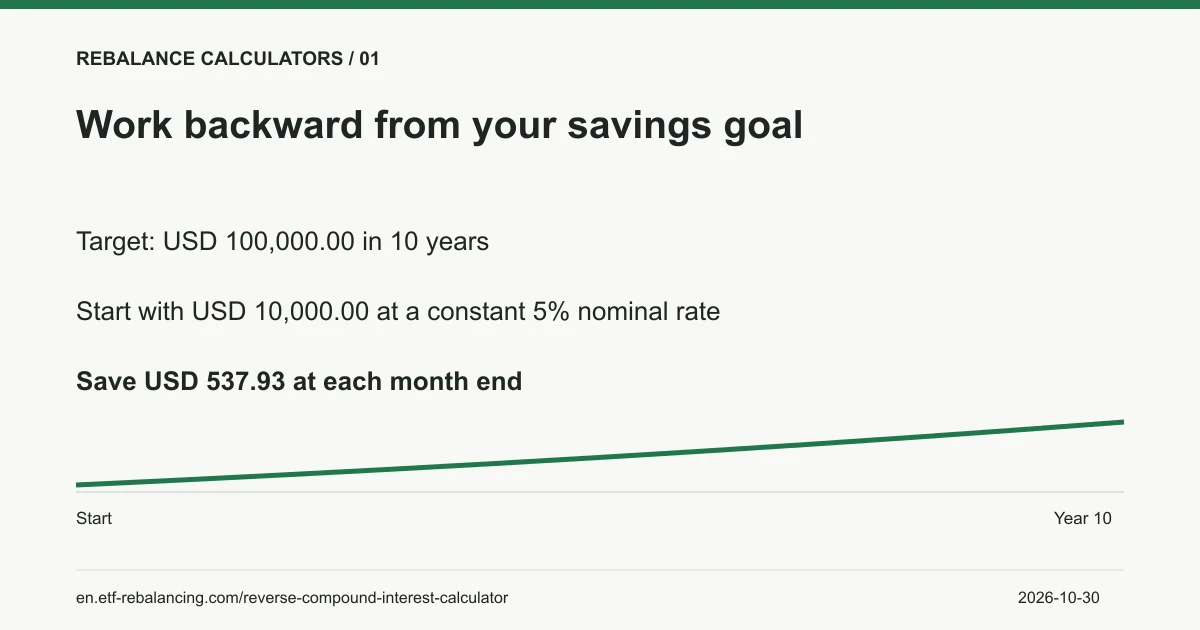
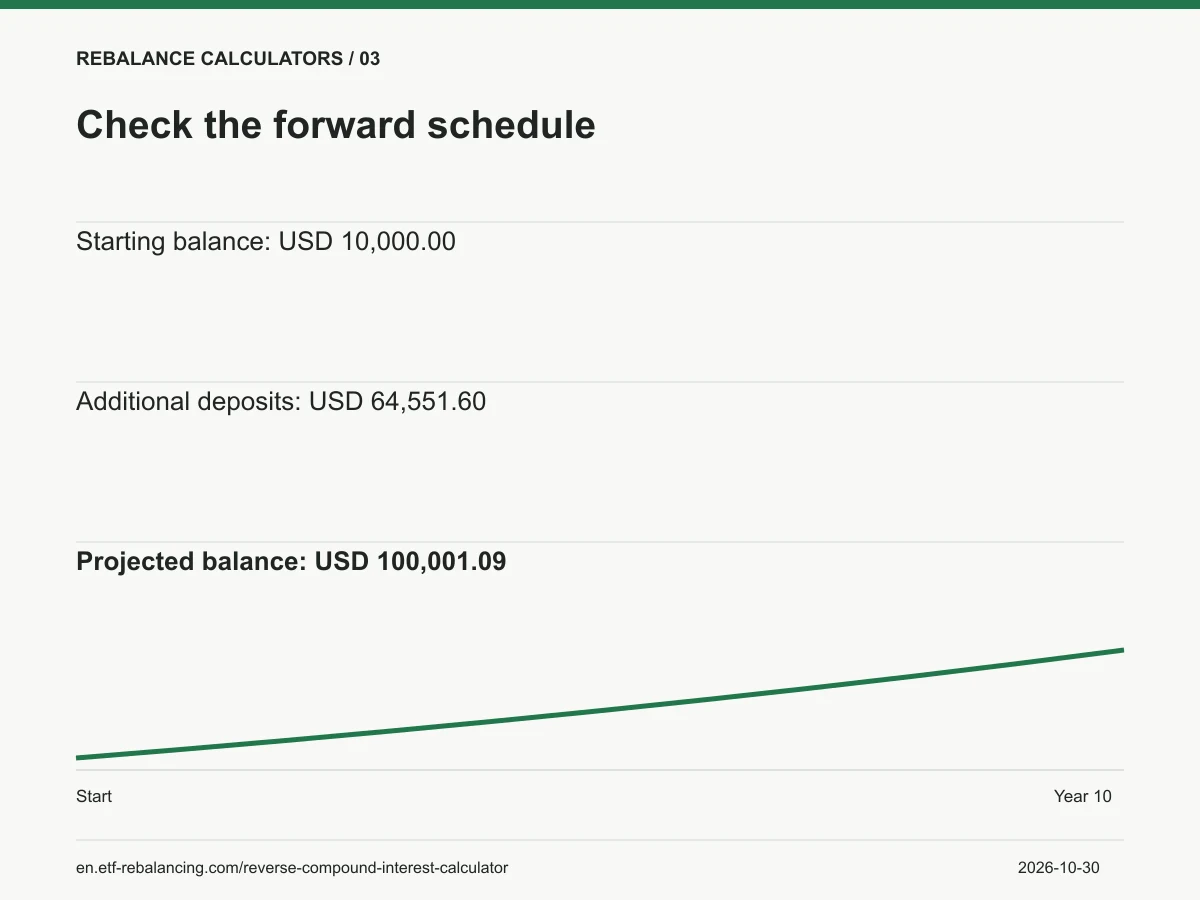
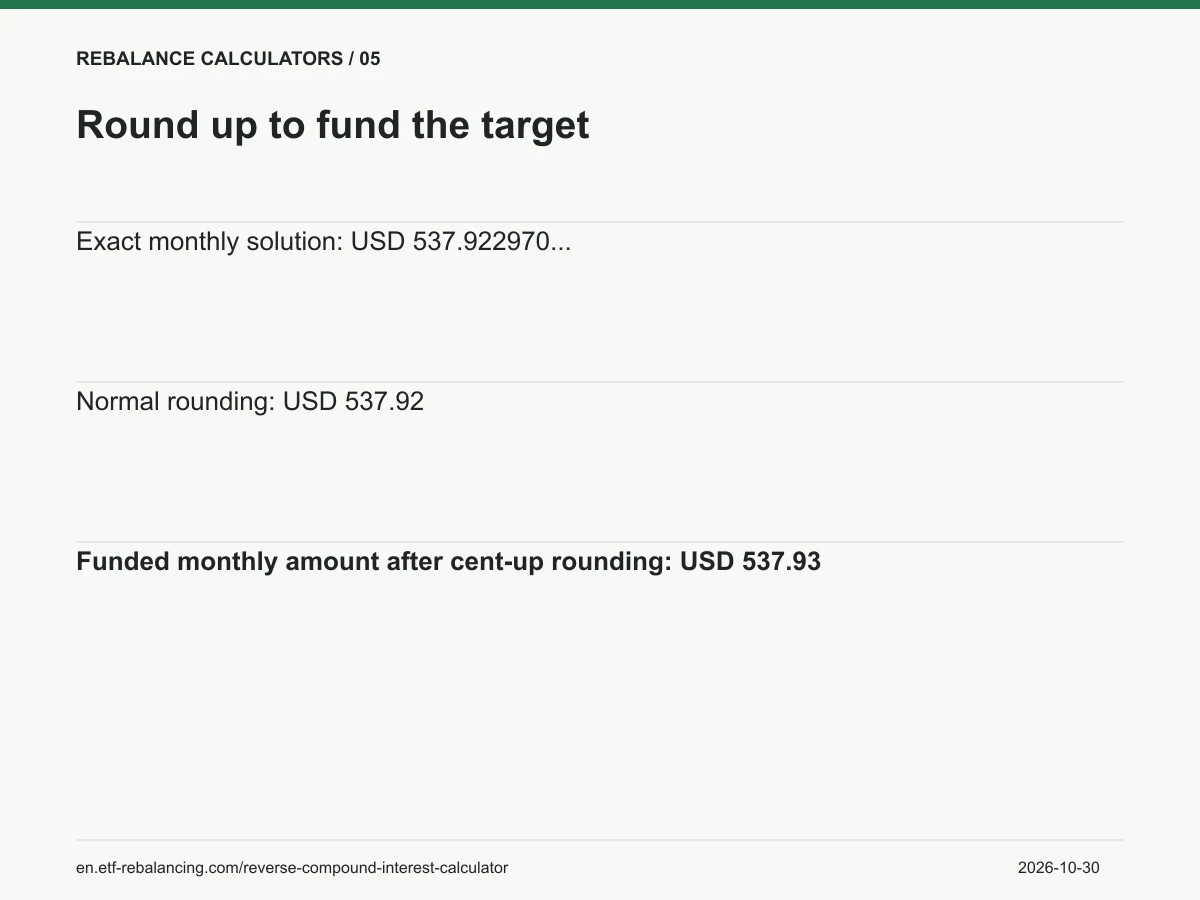
For example, to target USD 100,000.00 in 10 years from USD 10,000.00, a constant 5% nominal annual rate compounded monthly requires USD 537.93 per month. With month-end deposits, the forward calculation reaches USD 100,001.09. The solved deposit is rounded up to cents so the target is funded within this model.
How to calculate reverse compound interest
Let F be your target, P your starting amount, M your end-of-month deposit, r the nominal annual rate divided by 1,200, and n the number of years multiplied by 12. The forward equation is F = P × (1 + r)ⁿ + M × A, where A = ((1 + r)ⁿ − 1) / r.
- Required monthly saving: M = (F − P × (1 + r)ⁿ) / A.
- Required starting amount: P = (F − M × A) / (1 + r)ⁿ.
- At a 0% rate, use A = n. The model never divides by zero.
A negative solution means the known funds or deposits already meet the target. We show zero additional funding. Otherwise, we round the solved amount up to cents and run the complete forward schedule to verify it. Negative constant rates are supported as loss scenarios within the input limits.
The rate is nominal, compounded monthly. For example, 5% nominal produces about 5.116% effective annual growth before cash flows. Entering 5% APY as a 5% nominal rate would overstate growth. This tool does not convert an account’s APY automatically.
Checked against real savings-goal calculations
On October 30, 2026, we entered the scenarios below into the named reference calculators. These comparisons check a model convention; they do not imply endorsement.
| Scenario and reference | Visible reference output | Our result |
|---|---|---|
| Investor.gov: $100,000 target, $10,000 saved today | $537.92 monthly | USD 537.93 monthly, rounded up |
| Compound Interest Tools: 25,000 target, no later deposits | 15,179.03 starting amount | USD 15,179.03 starting amount |
The exact monthly solution for the first example is about $537.922970. Investor.gov displays normal cent rounding, $537.92; this tool uses cent-up rounding, $537.93, then verifies the resulting balance. The second reference was observed in its default GBP display. Currency labels do not change this untaxed arithmetic; our USD example uses the same numerical conditions.
Where your money comes from
The example’s USD 100,001.09 balance consists of the initial USD 10,000.00, USD 64,551.60 in later deposits and USD 25,449.49 in modeled interest. Deposits are your own money, rather than investment gains.
| Year | Deposited that year | Interest that year | Closing balance |
|---|---|---|---|
| 1 | USD 6,455.16 | USD 661.62 | USD 17,116.78 |
| 5 | USD 6,455.16 | USD 2,233.69 | USD 49,416.10 |
| 10 | USD 6,455.16 | USD 4,695.75 | USD 100,001.09 |
Build and save your own savings plan
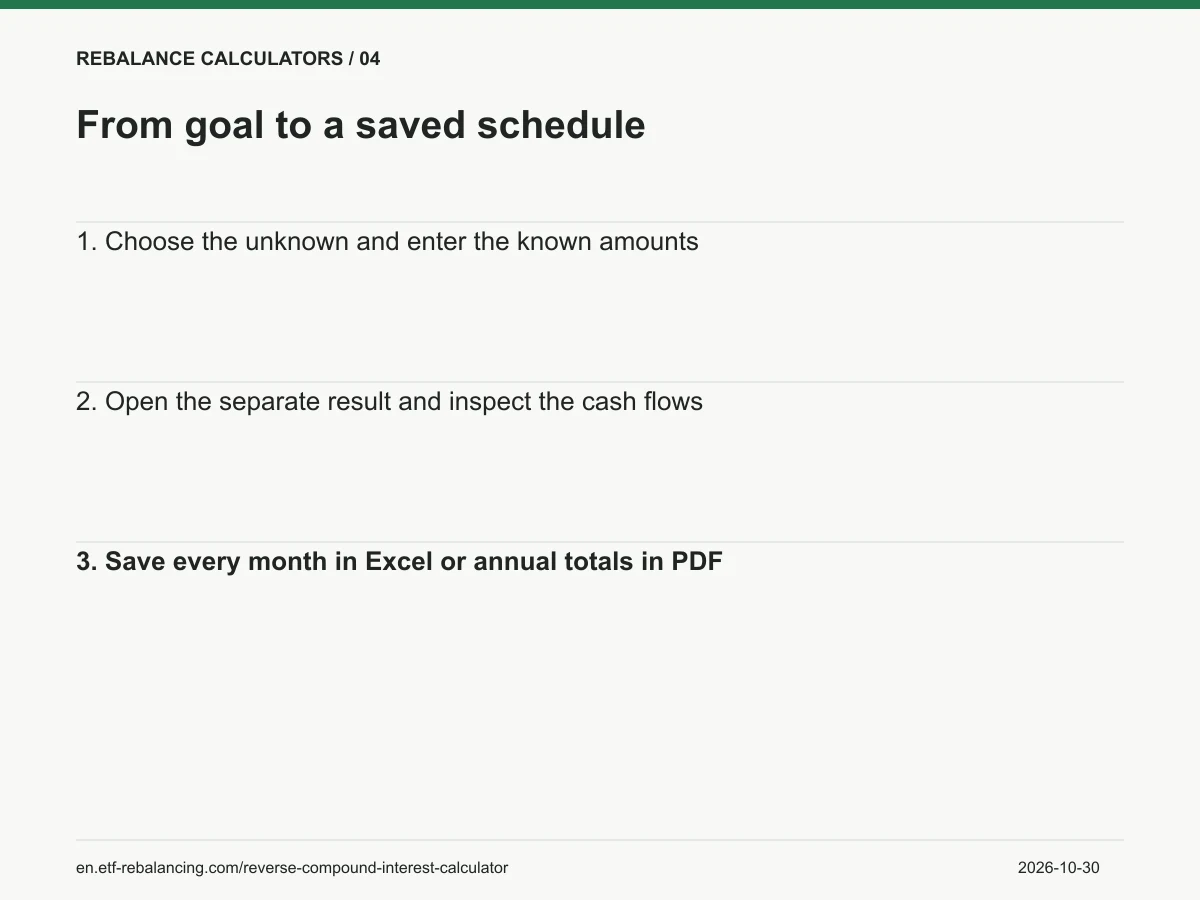
- Choose the amount to solve for. Enter the target and either today’s savings or a known monthly deposit.
- Set the currency label, whole-year duration and illustrative nominal annual rate.
- Choose View results. Read the required amount alongside the projected balance and the annual or monthly cash-flow table.
- Download a real Excel document with every modeled month, or a PDF with your assumptions and annual schedule. Return to change inputs and compare a new scenario.
Your values remain in this browser tab for up to 24 hours. Results have a separate address, but the address does not contain or share your financial inputs. A new tab without saved inputs asks you to open the calculator.
Why the ending balance can exceed the goal
Rounding the required deposit upward by less than one cent each month adds a small surplus over time. That is intentional: rounding to the nearest cent could leave a shortfall. The starting-amount mode applies the same cent-up rule to the initial lump sum.
Assumptions and limits
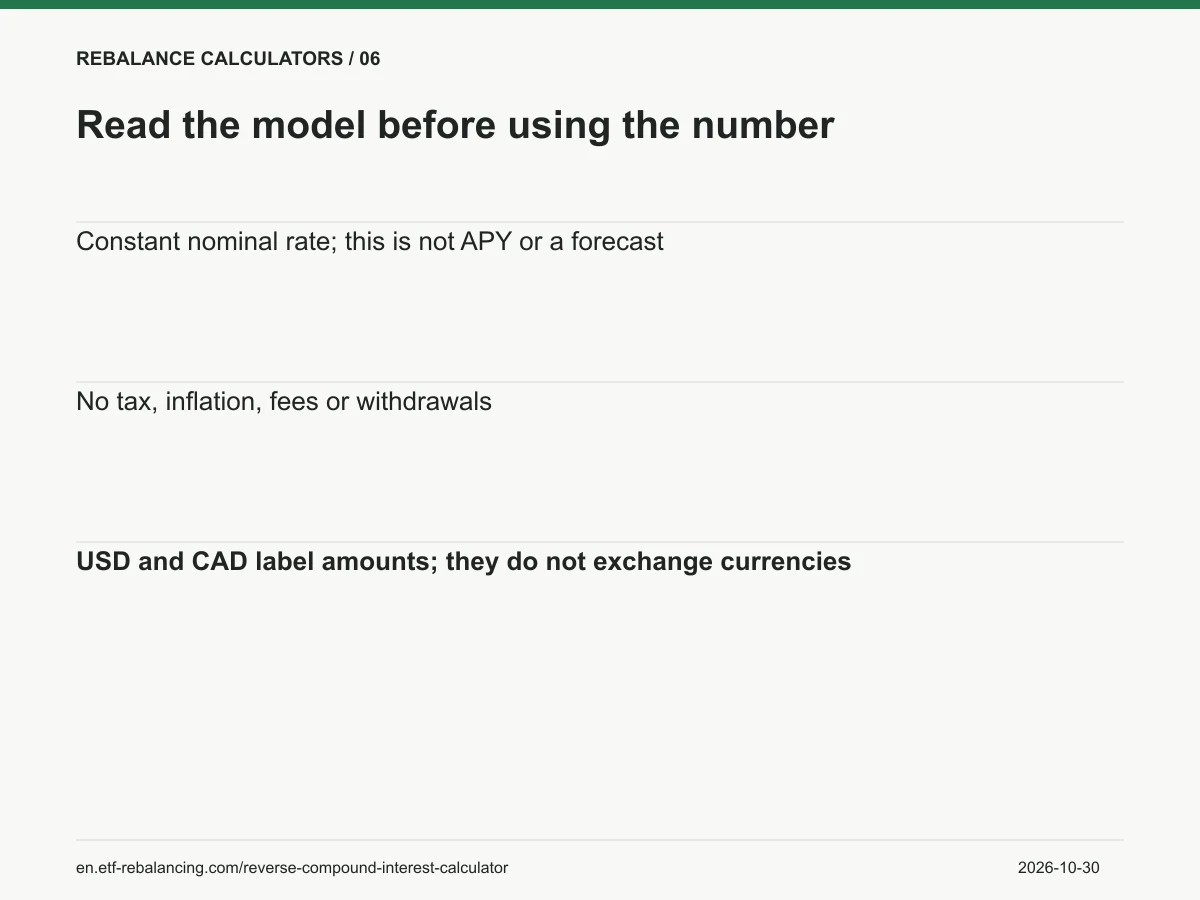
- The same nominal annual rate applies every month. Actual investment returns vary, so a result is a scenario rather than a guaranteed savings plan.
- Deposits arrive at month end, after that month’s interest. Beginning-of-month deposits would produce a different answer.
- Tax, account fees, inflation and withdrawals are excluded. The goal is a future nominal amount, not today’s purchasing power.
- USD and CAD change labels only. No exchange rate or country-specific account tax treatment is applied.
- The model accepts 1–50 whole years, rates from −50% to 50%, targets and starting amounts up to 100 million, and monthly deposits up to 1 million. Unreliable or oversized scenarios show an error.
Common questions
Can I calculate the initial investment with no monthly deposits?
Yes. Select Starting amount and enter 0 for the known monthly deposit. For a $25,000 target in 10 years at 5% nominal interest compounded monthly, the required lump sum is USD 15,179.03 after rounding up to cents.
Can I solve for the interest rate or the number of years?
This calculator solves the starting amount or monthly saving. The rate and duration are inputs. You can change them to compare scenarios; it does not solve an unknown rate or a fractional date.
Is the Excel download an editable formula template?
It contains the actual calculated summary, model notes, monthly rows and annual rows for your inputs. It does not contain spreadsheet formulas that recalculate when edited. Change inputs here to create a new export.
What if my savings already exceed the target?
The required additional amount is zero under the entered rate and time assumptions. The result still shows the forward balance, so you can see how the known money is modeled.
Sources and reference scenarios
- SEC Investor.gov Savings Goal Calculator — actual monthly-saving example and compounding convention.
- Compound Interest Tools reverse calculator — actual starting-amount comparison and the limits of its single-unknown workflow.
This independent calculator is published by Rebalance Calculators. Our verification standards explain how examples and corrections are handled.